
Brown roll-rim (Paxillus involutus): How to Recognise It
Quick answer
Brown roll-rim, Paxillus involutus: immune-mediated, can be fatal. Cap, gills, stem and habitat to check, what it is confused with, and what to do after a suspected ingestion. Not a guide to eating.
Updated 2026-09-10 · Sources: Wikipedia, first-nature.com
Take a photo to learn what it might be. Never eat a wild mushroom based on an app or a website.
Download on the App StoreWhat are the key facts?
- Scientific name: Paxillus involutus
- Common names: brown roll-rim, poison pax
- Toxin: immune-mediated (paxillus syndrome, autoimmune hemolysis)
- Severity: can be fatal
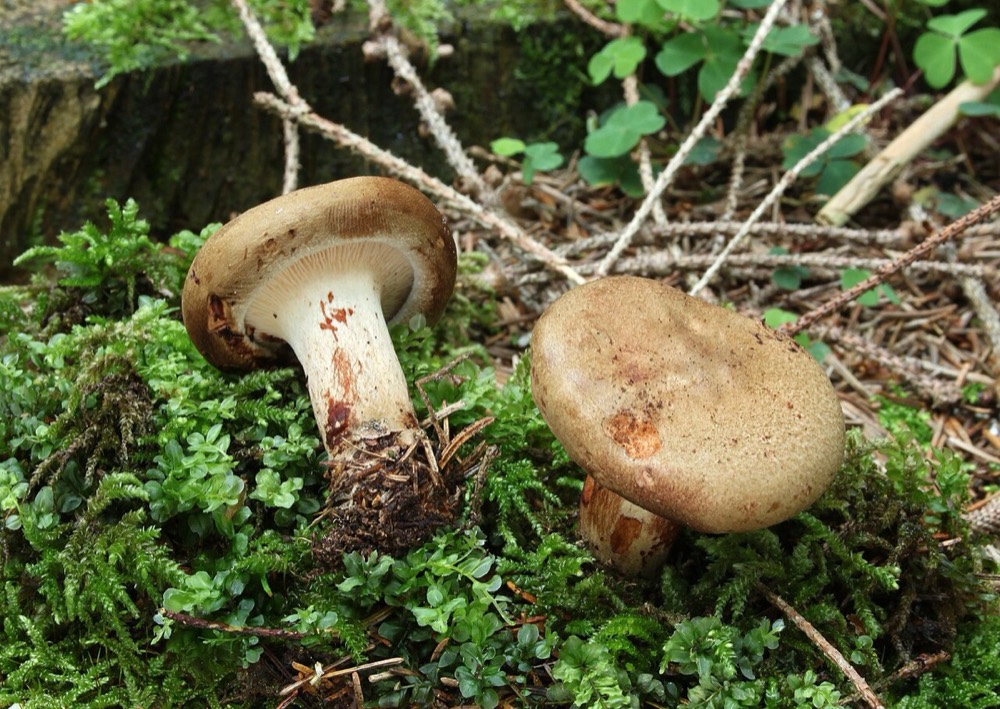
- Cap: Funnel-shaped, with a distinctly inrolled margin; 4-12 cm wide.
- Gills: Decurrent, sometimes forked, easily peeled from the cap flesh, quickly turning brown/rusty brown when bruised.
- Stem, ring and volva: Stem 3-6 cm tall, 1-3 cm thick, often curved, tapering toward the base, no ring.
- Spore print: Brown (ochre-brown/sienna).
- Where and when it grows: Deciduous and coniferous forests and old grassy lawns; forms mycorrhizal associations with birch and other broadleaf trees; July-October in the UK.
- Range in North America: Present in North America; common across the temperate Northern Hemisphere.
How to recognise Brown roll-rim
- Cap: Funnel-shaped, with a distinctly inrolled margin; 4-12 cm wide.
- Gills: Decurrent, sometimes forked, easily peeled from the cap flesh, quickly turning brown/rusty brown when bruised.
- Stem, ring and volva: Stem 3-6 cm tall, 1-3 cm thick, often curved, tapering toward the base, no ring.
- Spore print: Brown (ochre-brown/sienna).
- Where and when it grows: Deciduous and coniferous forests and old grassy lawns; forms mycorrhizal associations with birch and other broadleaf trees; July-October in the UK.
- Range in North America: Present in North America; common across the temperate Northern Hemisphere.
Easily confused with
- milk-cap mushrooms, Lactarius species: The brown roll-rim does not exude milky latex when bruised.
What happens if it is eaten
Toxin: immune-mediated (paxillus syndrome, autoimmune hemolysis). Severity: can be fatal. A delayed start is the dangerous part: hours without symptoms do not mean the mushroom was harmless.
What to do if someone may have eaten it
Call Poison Control at 1-800-222-1222 (U.S.) right away, or your local emergency number. Keep any leftover mushroom, a photo of it, and note when it was eaten. Do not wait for symptoms and do not try home remedies. This page does not give medical advice.
What a photo can and cannot do
A clear photo of the whole mushroom, including the base dug out of the ground, the gills and a spore print, lets the app and a mycologist narrow down what it might be and flag features that match Brown roll-rim. No photo, app or website can confirm that a wild mushroom is safe to eat. Use identification to know what to avoid, not what to cook.
FAQ
Is brown roll-rim deadly?
Brown roll-rim is classed here as: can be fatal. Its toxin is immune-mediated (paxillus syndrome, autoimmune hemolysis). Treat any suspected ingestion as an emergency.
Where does brown roll-rim grow?
Deciduous and coniferous forests and old grassy lawns; forms mycorrhizal associations with birch and other broadleaf trees; July-October in the UK.
Can the app tell me if a mushroom is safe to eat?
No. The app helps you see which features match known species, including toxic ones, so you know what to stay away from. It never declares a wild mushroom safe.
More in Toxic Mushrooms of North America
- Death Cap Mushrooms (Amanita phalloides): ID and Danger
- Destroying Angel Mushroom (Amanita bisporigera): How to ID
- Western destroying angel (Amanita ocreata): How to Recognise It
- Funeral Bell Mushroom (Galerina marginata): How to ID It
- False Morel Mushrooms (Gyromitra): Poisonous, How to Tell
- Fool's conecap (Conocybe filaris): How to Recognise It
- Deadly Lepiota (Lepiota brunneoincarnata): How to Recognise It
- Deadly webcap (Cortinarius rubellus): How to Recognise It
Related
Learn what's growing around you.
Start with a single scan.
Take a photo to learn what it might be. Never eat a wild mushroom based on an app or a website.
Sources
- Wikipediaen.wikipedia.org/wiki/Paxillus_involutus
- first-nature.comwww.first-nature.com/fungi/paxillus-involutus.php
Compiled by the MushroomLens editorial team
Every fact on this page is taken from the sources listed above; numbers and prices are copied from the source, and prices name the guide or auction and its date. Research and drafting were assisted by AI, and each claim was then checked against the cited sources. Checked 2026-09-10. We do not buy, sell or grade items; the app identifies what you photograph and points you to these references.