
Funeral Bell Mushroom (Galerina marginata): How to ID It
Quick answer
The funeral bell mushroom carries the same amatoxins as the death cap; about 10 caps could poison a 20 kg child. How to tell it from honey fungus.
Updated 2026-09-25 · Sources: Wikipedia, MushroomExpert.com, wildfooduk.com, inaturalist.org
Take a photo to learn what it might be. Never eat a wild mushroom based on an app or a website.
Download on the App StoreWhat are the key facts?
- Scientific name: Galerina marginata
- Common names: deadly galerina, funeral bell, autumn skullcap
- Toxin: amatoxins (liver and kidney damage, delayed onset)
- Severity: can be fatal
- First symptoms: Initial gastrointestinal symptoms (abdominal pain, vomiting, diarrhea) last 6 to 9 hours; if untreated, liver and kidney failure or even death can occur within 7 days.
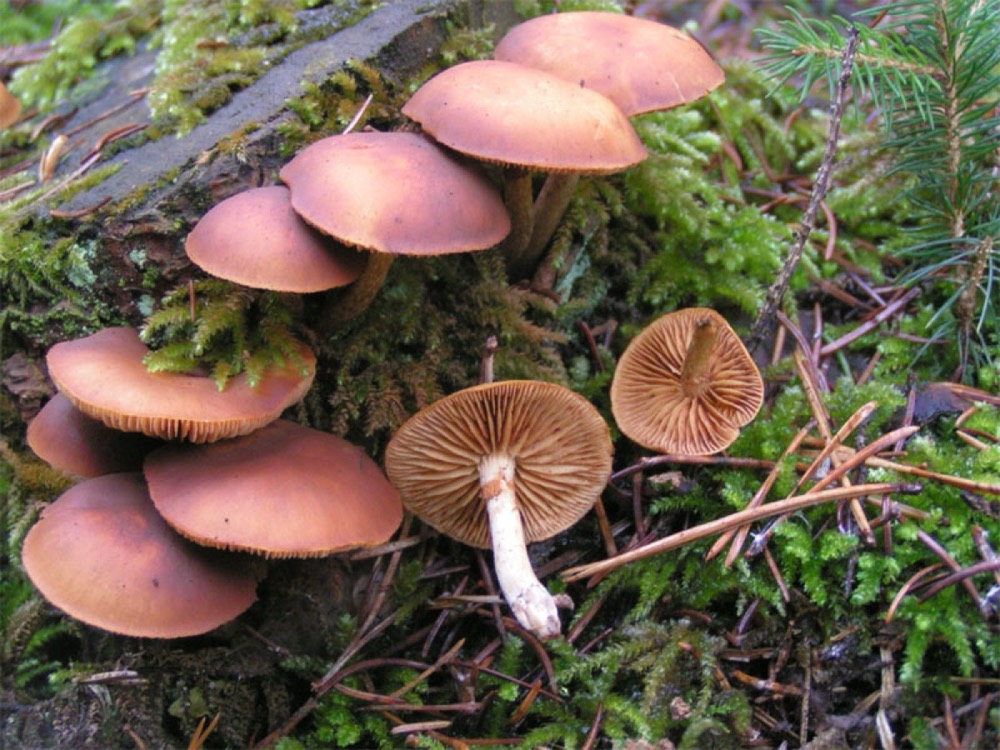
- Cap: Cap 1-6 cm (occasionally to 8 cm), honey-yellow with orange tones, becoming cinnamon to brownish-orange; fades when dry.
- Gills: Broadly adnate to nearly decurrent gills, yellow when young, becoming rusty brown at maturity.
- Stem, ring and volva: Thin, whitish to rusty-brown, bracelet-like ring; may be lost with age leaving only a zone, with no scales below the ring.
- Spore print: Rusty brown.
- Where and when it grows: Saprobic, growing on decaying conifer or hardwood wood; summer through autumn.
- Range in North America: Widely distributed and common in North America, from Canada's boreal forests to Mexico.
How to recognise Deadly galerina
- Cap: Cap 1-6 cm (occasionally to 8 cm), honey-yellow with orange tones, becoming cinnamon to brownish-orange; fades when dry.
- Gills: Broadly adnate to nearly decurrent gills, yellow when young, becoming rusty brown at maturity.
- Stem, ring and volva: Thin, whitish to rusty-brown, bracelet-like ring; may be lost with age leaving only a zone, with no scales below the ring.
- Spore print: Rusty brown.
- Where and when it grows: Saprobic, growing on decaying conifer or hardwood wood; summer through autumn.
- Range in North America: Widely distributed and common in North America, from Canada's boreal forests to Mexico.
Easily confused with
- honey mushroom, Armillaria mellea: Armillaria mellea has a white spore print.
- Pholiota species: Pholiota has a dark brown (rather than rusty brown) spore print, and the cap is often scaly.
- Hypholoma species: Hypholoma species are generally larger, with a dark brown to purplish-brown spore print.
What happens if it is eaten
Toxin: amatoxins (liver and kidney damage, delayed onset). Severity: can be fatal. Timing: Initial gastrointestinal symptoms (abdominal pain, vomiting, diarrhea) last 6 to 9 hours; if untreated, liver and kidney failure or even death can occur within 7 days. A delayed start is the dangerous part: hours without symptoms do not mean the mushroom was harmless.
What to do if someone may have eaten it
Call Poison Control at 1-800-222-1222 (U.S.) right away, or your local emergency number. Keep any leftover mushroom, a photo of it, and note when it was eaten. Do not wait for symptoms and do not try home remedies. This page does not give medical advice.
What a photo can and cannot do
A clear photo of the whole mushroom, including the base dug out of the ground, the gills and a spore print, lets the app and a mycologist narrow down what it might be and flag features that match Deadly galerina. No photo, app or website can confirm that a wild mushroom is safe to eat. Use identification to know what to avoid, not what to cook.
How toxic is the funeral bell?
The funeral bell contains alpha- and gamma-amanitin, the same liver toxins as the death cap. Wikipedia cites measurements of 1.1 to 1.5 mg per gram of dried mushroom, with some specimens exceeding levels found in death caps, and estimates that about 10 fruit bodies could poison a 20 kg child. Wild Food UK describes it as very poisonous, with the same toxins as the deathcap, and rates it fairly common in the UK.
Wikipedia counts about ten poisonings reported in the literature between 1978 and 1995, including two deaths in Washington State. Symptoms begin with severe abdominal pain, vomiting and diarrhoea lasting six to nine hours; liver failure, kidney failure or death can follow within seven days.
Funeral bell vs honey fungus
Both grow in clusters on wood in autumn and both are brownish, so the mistake is common. The checks:
- Spore print. Funeral bell prints rusty brown (Wild Food UK: snuff brown). Honey fungus (Armillaria mellea) prints white. This is the deciding test.
- Size. Funeral bell caps are 2 to 6 cm (Wild Food UK); honey fungus caps are 3 to 15 cm (Wikipedia).
- Ring. Honey fungus has a broad, persistent, skin-like ring. The funeral bell's ring is thin and fragile and often disappears, leaving only a zone.
- Bootlaces. Honey fungus has black bootlace-like rhizomorphs under bark and in soil; the funeral bell does not.
- Where. Funeral bell grows mainly on rotting conifer wood, but Wild Food UK also finds it on broadleaf stumps, woodchips and open grassland.
A spore print takes a few hours. Until it is done, and until an expert has confirmed it, treat any small brown mushroom on wood as possibly deadly.
Other look-alikes: sheathed woodtuft, velvet shank, sulphur tuft
- Sheathed woodtuft (Kuehneromyces mutabilis). Wild Food UK says it looks too much like the funeral bell to be a safe mushroom to collect. Wikipedia separates it by scales on the stem up to the ring, a larger cap and a spicy smell, and by smooth rather than warty spores under a microscope.
- Velvet shank (Flammulina velutipes). Black, velvety stem with no ring, and a white spore print.
- Psilocybe species. Wikipedia warns that people looking for psychoactive mushrooms have confused the funeral bell with them.
- [Sulphur tuft](/lookup/edible-mushroom-lookalikes/sulphur-tuft). Yellow, clumped on wood, with greenish gills and a purple-brown spore print; poisonous itself.
How deadly is deadly galerina? The numbers
Wikipedia cites a 2004 analysis that measured 78.17 to 243.61 micrograms of amatoxins per gram of fresh funeral bell, and puts the lethal dose for people at about 0.1 mg per kg of body weight, or even lower. Put together, those figures mean a 70 kg adult could reach a lethal dose from roughly 30 to 90 grams of fresh mushroom, and a child from far less. That arithmetic is only an illustration: toxin content varies from one specimen to the next, and any amount eaten is an emergency. The toxins are the same amatoxins found in the death cap; the stages and treatment are on amatoxin poisoning.
Tom Volk of the University of Wisconsin describes the course: symptoms 6 to 24 hours after eating, starting with unease and then severe cramps and diarrhoea, a false improvement around day three, then rising liver enzymes and organ failure on days four and five. Call Poison Control at 1-800-222-1222 (U.S.) before any of that starts.
How to identify deadly galerina: a field checklist
Measurements from Michael Kuo's MushroomExpert.com description:
- Cap: 1.5 to 5 cm, rarely up to 8 cm; honey yellow with an orange tint at first, becoming cinnamon to brownish orange; sticky when wet, bald.
- Gills: broadly attached or starting to run down the stem; yellowish at first, rusty brown as the spores mature.
- Stem: 2 to 7.5 cm long and 3 to 8 mm thick; whitish to brownish, darkening to dark reddish brown from the base upwards.
- Ring: thin, whitish to rusty brown, bracelet-like, and often lost, leaving only a zone.
- Spore print: rusty brown.
- Growth: usually in clusters on rotting hardwood or conifer wood.
- Season: Kuo says most frequent in spring and autumn but found year-round; Volk says it fruits year-round wherever snow allows.
The last point matters: the funeral bell is not only an autumn mushroom, so a small brown cluster on wood in spring deserves the same caution.
Galerina and magic-mushroom hunters
Wikipedia reports that several Galerina poisonings happened when collectors ate it after mistaking it for the hallucinogenic Psilocybe stuntzii, and Tom Volk also names Psilocybe species as a lookalike. On spore colour, MushroomExpert.com's key places Psilocybe with the purple-brown to blackish prints and Galerina with the rusty to cinnamon-brown ones, but those shades can be hard to judge by eye, and a spore print is not a safe way to sort them. This site does not help anyone pick psilocybin mushrooms; the point here is that a small brown mushroom picked for any reason may be a funeral bell.
Old names you may see in books
Older field guides and articles treat several of these mushrooms as separate species. Wikipedia lists Galerina autumnalis, Galerina venenata, Galerina oregonensis and Galerina unicolor as names now folded into Galerina marginata. Tom Volk's University of Wisconsin page, for example, calls it Galerina autumnalis, the autumn skullcap, and the two deaths in Washington State that Wikipedia records were attributed to G. venenata. If a guide describes any of these, it is describing the same danger.
Volk also records poisonings among immigrants near Chicago who believed that mushrooms growing on wood were always safe to eat. That belief is wrong: the funeral bell grows on wood.
FAQ
Is deadly galerina deadly?
Deadly galerina is classed here as: can be fatal. Its toxin is amatoxins (liver and kidney damage, delayed onset). Treat any suspected ingestion as an emergency.
Where does deadly galerina grow?
Saprobic, growing on decaying conifer or hardwood wood; summer through autumn.
Can the app tell me if a mushroom is safe to eat?
No. The app helps you see which features match known species, including toxic ones, so you know what to stay away from. It never declares a wild mushroom safe.
Is the Funeral Bell mushroom toxic?
Yes, deadly. It contains the same amatoxins as the death cap, and Wikipedia estimates about 10 fruit bodies could poison a 20 kg child.
How can I tell the difference between honey fungus and funeral bell?
Take a spore print: rusty brown means funeral bell, white means honey fungus. Honey fungus is also larger, has a broad skin-like ring and black bootlace strands. Get an expert to confirm before anyone eats either.
What are the symptoms of galerina poisoning?
Severe abdominal pain, vomiting and diarrhoea lasting six to nine hours, often after a delay, then possible liver and kidney failure within seven days. Call Poison Control at 1-800-222-1222 (U.S.) now, before symptoms start.
What is the most poisonous mushroom in the world?
The death cap is usually named because it causes most mushroom deaths, but the funeral bell carries the same toxins and some specimens have tested higher than death caps.
How deadly is Galerina?
As deadly as the death cap: it carries the same amatoxins. Wikipedia cites 78.17 to 243.61 micrograms per gram of fresh mushroom and a lethal dose near 0.1 mg per kg of body weight, and records two deaths in Washington State. Call Poison Control at 1-800-222-1222 (U.S.) after any bite.
How to identify deadly Galerina?
A small brown mushroom, cap 1.5 to 5 cm, growing in clusters on rotting wood, with a thin ring that often disappears, a stem darkening from the base up, and a rusty brown spore print (MushroomExpert.com). Any small brown mushroom on wood should be treated as possibly deadly until an expert confirms it.
What is the deadliest fungus to humans?
The death cap, Amanita phalloides, which causes most fatal mushroom poisonings. The funeral bell carries the same amatoxins, and Wikipedia reports some specimens with more toxin than death caps. See [death cap](/lookup/toxic-mushrooms/amanita-phalloides).
More in Toxic Mushrooms of North America
- Death Cap Mushrooms (Amanita phalloides): ID and Danger
- Destroying Angel Mushroom (Amanita bisporigera): How to ID
- Western destroying angel (Amanita ocreata): How to Recognise It
- False Morel Mushrooms (Gyromitra): Poisonous, How to Tell
- Fool's conecap (Conocybe filaris): How to Recognise It
- Deadly Lepiota (Lepiota brunneoincarnata): How to Recognise It
- Deadly webcap (Cortinarius rubellus): How to Recognise It
- Brown roll-rim (Paxillus involutus): How to Recognise It
Related
Learn what's growing around you.
Start with a single scan.
Take a photo to learn what it might be. Never eat a wild mushroom based on an app or a website.
Sources
- Wikipediaen.wikipedia.org/wiki/Galerina_marginata
- MushroomExpert.comwww.mushroomexpert.com/galerina_marginata.html
- wildfooduk.comwww.wildfooduk.com/mushroom-guide/funeral-bell/
- inaturalist.orgwww.inaturalist.org/taxa/154735-Galerina-marginata
- Wikipediaen.wikipedia.org/wiki/Armillaria_mellea
- wildfooduk.comwww.wildfooduk.com/articles/the-most-poisonous-uk-fungi-part-1/
- botit.botany.wisc.edubotit.botany.wisc.edu/toms_fungi/may2003.html
- MushroomExpert.comwww.mushroomexpert.com/gilled_dark.html
- Wikipediaen.wikipedia.org/wiki/Amatoxin
Compiled by the MushroomLens editorial team
Every fact on this page is taken from the sources listed above; numbers and prices are copied from the source, and prices name the guide or auction and its date. Research and drafting were assisted by AI, and each claim was then checked against the cited sources. Checked 2026-09-25. We do not buy, sell or grade items; the app identifies what you photograph and points you to these references.