
Death Cap Mushrooms (Amanita phalloides): ID and Danger
Quick answer
Death cap mushrooms cause most mushroom-poisoning deaths. California logged 50 cases and 4 deaths from Nov 2025 to May 2026. How to recognise one.
Updated 2026-09-25 · Sources: Wikipedia, first-nature.com, cdph.ca.gov, bccdc.ca
Take a photo to learn what it might be. Never eat a wild mushroom based on an app or a website.
Download on the App StoreWhat are the key facts?
- Scientific name: Amanita phalloides
- Common names: death cap
- Toxin: amatoxins (liver and kidney damage, delayed onset)
- Severity: can be fatal
- First symptoms: Gastrointestinal symptoms appear 6 to 12 hours after ingestion; after this improves, more severe organ damage follows 2 to 3 days later.
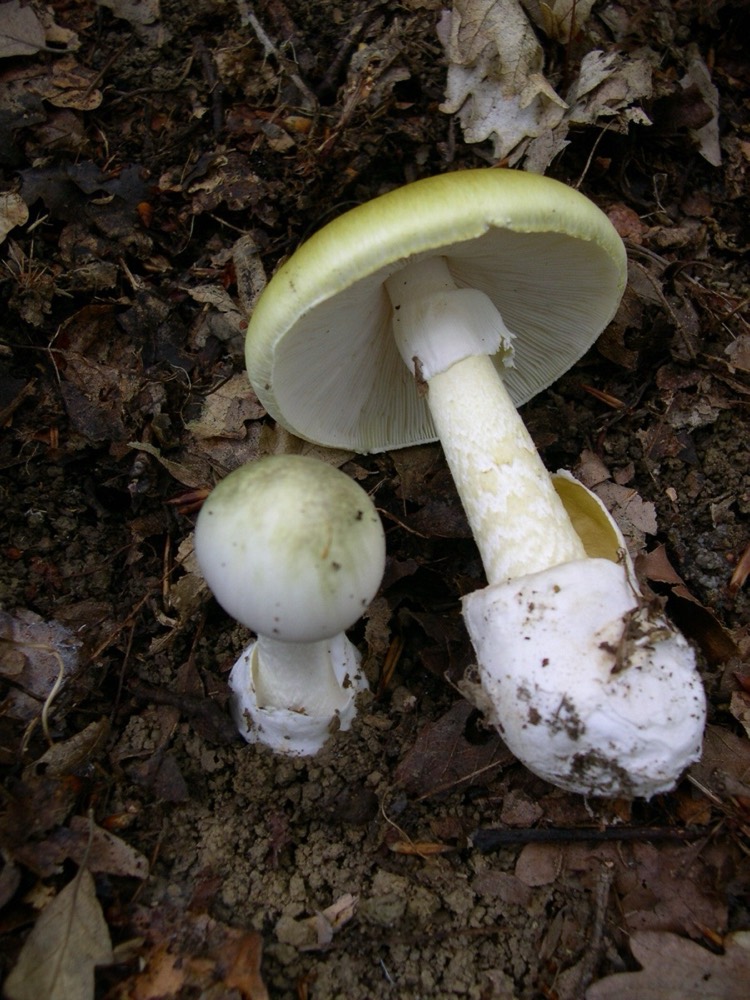
- Cap: Cap 5-15 cm wide; color can be pale green, yellowish-green, olive-green, bronze, or white; sticky when wet, cuticle easily peeled.
- Gills: White, crowded, free gills.
- Stem, ring and volva: Stem 8-15 cm long, white with grayish-olive scales; skirt-like, easily drooping ring; base has a swollen, ragged, sac-like white volva (sometimes tinged green inside).
- Spore print: White.
- Where and when it grows: Forms ectomycorrhizal associations with broadleaf trees (oak, beech, etc.); fruits in summer and autumn (July-November in the UK).
- Range in North America: An introduced species native to Europe that has become established on both the west and east coasts of North America.
How to recognise Death cap
- Cap: Cap 5-15 cm wide; color can be pale green, yellowish-green, olive-green, bronze, or white; sticky when wet, cuticle easily peeled.
- Gills: White, crowded, free gills.
- Stem, ring and volva: Stem 8-15 cm long, white with grayish-olive scales; skirt-like, easily drooping ring; base has a swollen, ragged, sac-like white volva (sometimes tinged green inside).
- Spore print: White.
- Where and when it grows: Forms ectomycorrhizal associations with broadleaf trees (oak, beech, etc.); fruits in summer and autumn (July-November in the UK).
- Range in North America: An introduced species native to Europe that has become established on both the west and east coasts of North America.
What happens if it is eaten
Toxin: amatoxins (liver and kidney damage, delayed onset). Severity: can be fatal. Timing: Gastrointestinal symptoms appear 6 to 12 hours after ingestion; after this improves, more severe organ damage follows 2 to 3 days later. A delayed start is the dangerous part: hours without symptoms do not mean the mushroom was harmless.
What to do if someone may have eaten it
Call Poison Control at 1-800-222-1222 (U.S.) right away, or your local emergency number. Keep any leftover mushroom, a photo of it, and note when it was eaten. Do not wait for symptoms and do not try home remedies. This page does not give medical advice.
What a photo can and cannot do
A clear photo of the whole mushroom, including the base dug out of the ground, the gills and a spore print, lets the app and a mycologist narrow down what it might be and flag features that match Death cap. No photo, app or website can confirm that a wild mushroom is safe to eat. Use identification to know what to avoid, not what to cook.
How poisonous is the death cap?
Extremely. Wikipedia's summary of the medical literature estimates that about 30 grams, roughly half a cap, can kill an adult, and attributes about 90% of mushroom-related deaths each year to this one species. Its amatoxins are not destroyed by cooking, freezing or drying.
The danger is made worse by timing. The first vomiting and diarrhoea start 6 to 12 hours after eating, then ease off for a day or two while the liver is being damaged; serious liver involvement follows 3 to 6 days after the meal. The British Columbia Centre for Disease Control (BCCDC) describes the same pattern: nausea and vomiting 8 to 12 hours after eating, an apparent recovery for up to 72 hours, then liver and kidney damage 3 to 6 days after ingestion.
Mortality has fallen with modern treatment. Wikipedia cites 60 to 70% in the mid-20th century and around 10 to 15% in surveys from 1995.
Where death caps grow in the U.S. and Canada
The death cap is native to Europe and was introduced to North America, apparently with imported trees. Wikipedia describes established populations on both the West and East Coasts of the United States, and in coastal California it grows with coast live oak. Californian specimens often have yellowish caps that can resemble the edible Amanita velosa.
CDPH lists the California counties with hospitalisations during the 2025-26 outbreak: Alameda, Contra Costa, Humboldt, Monterey, San Francisco, San Luis Obispo, San Mateo, Sacramento, Santa Clara, Santa Cruz, Sonoma and Yuba. CDPH notes these mushrooms appear in neighbourhoods and parks, not only in wild areas.
In Canada, BCCDC says the known range in British Columbia includes Vancouver Island and the Lower Mainland, where it arrived on the roots of boulevard trees planted in Victoria and Vancouver. In October 2016 a child died after eating a mushroom picked in downtown Victoria.
California's 2025-26 death cap outbreak in numbers
CDPH's outbreak table covers 18 November 2025 to 19 May 2026: 50 cases, 4 deaths and at least 4 liver transplants, caused by death caps and western destroying angels growing in unusual numbers and in places they are not usually found. PBS NewsHour reported on 7 February 2026, partway through, that a typical year sees 2 to 5 such cases in California.
CDPH also reports that most people affected who gave a preferred language named Spanish, and it publishes warnings in Spanish, Mam, Mixteco, Mandarin, Ukrainian, Russian and English. Its message is the same in every language: the safest choice is not to pick and eat wild mushrooms, and not to eat wild mushrooms picked by friends or family.
The deadliest mushrooms compared
Searches for the most poisonous mushroom in the world usually mean this short list. Each links to a full identification page.
- Death cap (Amanita phalloides). Amatoxins; responsible for most mushroom deaths worldwide.
- Destroying angels ([Amanita bisporigera](/lookup/toxic-mushrooms/amanita-bisporigera), [Amanita ocreata](/lookup/toxic-mushrooms/amanita-ocreata), Amanita virosa). Same amatoxins, all-white. Together with the death cap they account for the overwhelming majority of mushroom-poisoning deaths (Wikipedia).
- Funeral bell ([Galerina marginata](/lookup/toxic-mushrooms/galerina-marginata)). A small brown mushroom on wood; Wikipedia reports some specimens with more amatoxin than death caps.
- Deadly dapperling ([Lepiota brunneoincarnata](/lookup/toxic-mushrooms/lepiota-brunneoincarnata)) and fool's conecap ([Conocybe filaris](/lookup/toxic-mushrooms/conocybe-filaris)). Small species carrying amatoxins.
- Deadly webcap ([Cortinarius rubellus](/lookup/toxic-mushrooms/cortinarius-rubellus)). Orellanine attacks the kidneys; Wild Food UK gives a delay of 2 to 17 days before symptoms.
- False morel ([Gyromitra esculenta](/lookup/toxic-mushrooms/gyromitra-esculenta)). Gyromitrin; can be fatal.
For contrast, the fly agaric is famous but rarely deadly: Wikipedia cites the North American Mycological Association as finding no reliably documented deaths from its toxins in the past 100 years. See fly agaric.
Is there a cure for death cap poisoning?
There is no home remedy and no antidote you can take yourself. Hospital treatment described in the literature summarised by Wikipedia includes activated charcoal, high-dose intravenous penicillin G, silibinin (from milk thistle), N-acetylcysteine and, when the liver fails, a liver transplant. Outcomes depend heavily on how early treatment starts.
BCCDC's instructions: go to an emergency room immediately if you suspect you ate a death cap, and bring specimens and the exact location where they were found. In the U.S., call Poison Control at 1-800-222-1222 (U.S.) now, before symptoms start; in British Columbia, the Drug & Poison Information Centre is 1-800-567-8911.
Death cap checklist for parents, dog owners and park crews
- Check under oaks after rain. In California, look under coast live oak; elsewhere, under imported hardwoods on streets and in parks.
- Dig out a whole suspicious mushroom with a tool. Look for a cup-like sac at the base; a snapped-off stem hides it.
- Wear gloves or use a bag over your hand, then wash your hands. CDPH says touching a poisonous mushroom usually does not pose a risk, but advises washing hands afterwards.
- Bag and bin it. Do not compost it where children or dogs can reach.
- Photograph and report. BCCDC asks people in British Columbia to report sightings; CDPH points medical providers to the North American Mycological Association's case reporting.
- Any bite eaten by a child or pet is an emergency: call Poison Control at 1-800-222-1222 (U.S.) now, before symptoms start, or call your veterinarian.
FAQ
Is death cap deadly?
Death cap is classed here as: can be fatal. Its toxin is amatoxins (liver and kidney damage, delayed onset). Treat any suspected ingestion as an emergency.
Where does death cap grow?
Forms ectomycorrhizal associations with broadleaf trees (oak, beech, etc.); fruits in summer and autumn (July-November in the UK).
Can the app tell me if a mushroom is safe to eat?
No. The app helps you see which features match known species, including toxic ones, so you know what to stay away from. It never declares a wild mushroom safe.
Where in the US do death cap mushrooms grow?
Mainly coastal California, where it grows with coast live oak, and parts of the East Coast where it arrived with imported trees. During the 2025-26 outbreak CDPH recorded hospitalisations in 12 California counties from Humboldt to San Luis Obispo.
How poisonous is the death cap mushroom?
About half a cap (roughly 30 g) is estimated to be enough to kill an adult, and its toxins survive cooking, freezing and drying (Wikipedia). California recorded 4 deaths among 50 cases between November 2025 and May 2026 (CDPH).
Can you touch death cap mushrooms?
CDPH says touching a poisonous mushroom usually does not pose a risk, but to wash your hands afterwards. Some authorities cited by Wikipedia go further and advise not touching death caps at all, so use gloves or a bag, keep them away from food, and keep children and pets away.
Is the death cap mushroom poisonous to touch?
Poisoning comes from eating it. CDPH says touching a poisonous mushroom usually does not pose a risk; wash your hands afterwards and never let the mushroom near food or a child's mouth.
What does the death cap taste like?
Survivors have reported that it tastes pleasant (Wikipedia), and CDPH warns that it can look and taste like safe mushrooms. Taste gives no warning at all, so never taste a wild mushroom to test it.
Is there a cure for Amanita phalloides?
There is no antidote you can take at home. Hospitals use drugs such as silibinin, N-acetylcysteine and high-dose penicillin G alongside intensive care, and some patients need a liver transplant. Treatment works best when it starts before symptoms appear.
Is Amanita muscaria fatal?
Rarely. Wikipedia cites the North American Mycological Association as finding no reliably documented deaths from fly agaric toxins in the past 100 years, but it still causes serious poisoning, so call Poison Control if anyone eats one.
What is the most poisonous mushroom in the world?
The death cap is usually named, because it causes most mushroom-poisoning deaths. Destroying angels and the funeral bell carry the same amatoxins, and some funeral bell specimens have tested higher than death caps.
Is there a way to tell poisonous and non-poisonous mushrooms apart?
Not by any simple rule. Poison Control says only experts in mushroom identification can tell the difference, and that cooking does not make a poisonous mushroom safe.
More in Toxic Mushrooms of North America
- Destroying Angel Mushroom (Amanita bisporigera): How to ID
- Western destroying angel (Amanita ocreata): How to Recognise It
- Funeral Bell Mushroom (Galerina marginata): How to ID It
- False Morel Mushrooms (Gyromitra): Poisonous, How to Tell
- Fool's conecap (Conocybe filaris): How to Recognise It
- Deadly Lepiota (Lepiota brunneoincarnata): How to Recognise It
- Deadly webcap (Cortinarius rubellus): How to Recognise It
- Brown roll-rim (Paxillus involutus): How to Recognise It
Related
Learn what's growing around you.
Start with a single scan.
Take a photo to learn what it might be. Never eat a wild mushroom based on an app or a website.
Sources
- Wikipediaen.wikipedia.org/wiki/Amanita_phalloides
- first-nature.comwww.first-nature.com/fungi/amanita-phalloides.php
- cdph.ca.govwww.cdph.ca.gov/Programs/CCDPHP/DEODC/EHIB/pages/eis/poisonous-mushrooms.aspx
- bccdc.cawww.bccdc.ca/health-info/prevention-public-health/death-cap-mushrooms
- pbs.orgwww.pbs.org/newshour/health/four-dead-and-three-receive-liver-transplants-after-
- wildfooduk.comwww.wildfooduk.com/articles/the-most-poisonous-uk-fungi-part-1/
- Wikipediaen.wikipedia.org/wiki/Amanita_muscaria
- Wikipediaen.wikipedia.org/wiki/Destroying_angel
- Poison Controlwww.poison.org/articles/wild-mushroom-warning
Compiled by the MushroomLens editorial team
Every fact on this page is taken from the sources listed above; numbers and prices are copied from the source, and prices name the guide or auction and its date. Research and drafting were assisted by AI, and each claim was then checked against the cited sources. Checked 2026-09-25. We do not buy, sell or grade items; the app identifies what you photograph and points you to these references.