
Destroying Angel Mushroom (Amanita bisporigera): How to ID
Quick answer
The destroying angel mushroom is an all-white Amanita with a ring and a sac-like cup; half a cap can be fatal. How it differs from the death cap.
Updated 2026-09-25 · Sources: Wikipedia, Missouri Dept. of Conservation, wildfooduk.com, cdph.ca.gov
Take a photo to learn what it might be. Never eat a wild mushroom based on an app or a website.
Download on the App StoreWhat are the key facts?
- Scientific name: Amanita bisporigera
- Common names: eastern destroying angel
- Toxin: amatoxins (liver and kidney damage, delayed onset)
- Severity: can be fatal
- First symptoms: Symptoms appear 5 to 24 hours after ingestion, by which time the toxins may already have been absorbed.
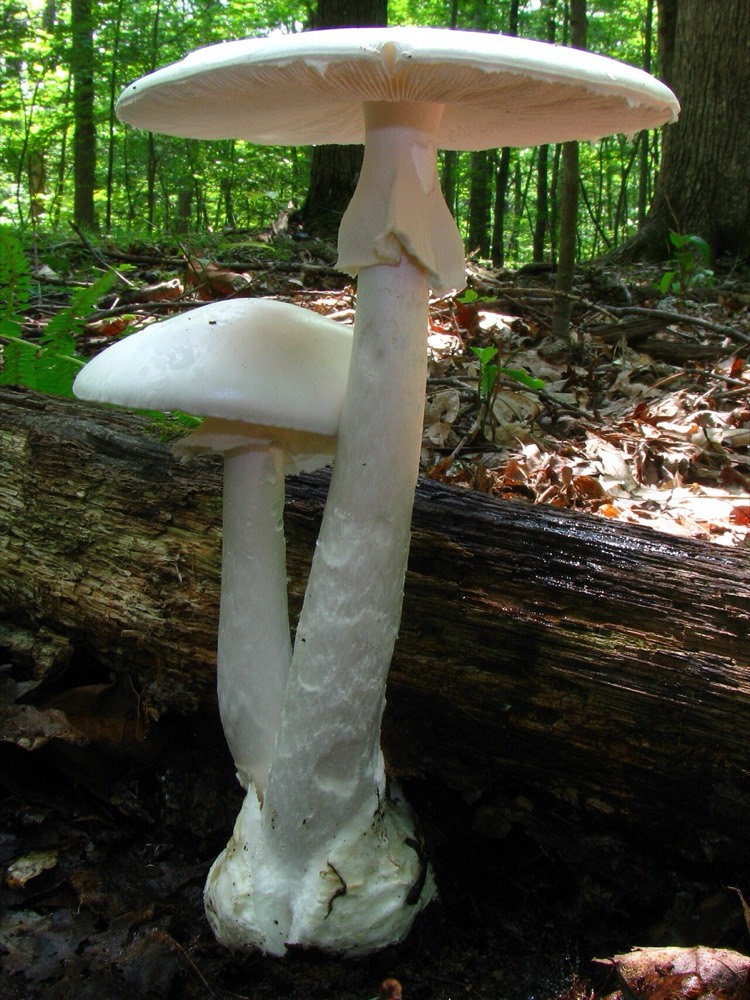
- Cap: Cap 3-13 cm wide, smooth, white, sometimes with pale brown or cream tones.
- Gills: White, closely spaced, free or nearly free gills.
- Stem, ring and volva: Stem 6-14 cm, white; has a white, thin, membranous ring; base has an egg-shell-like, sac-like volva.
- Spore print: White.
- Where and when it grows: Mixed coniferous and deciduous forests, near oaks; fruits from summer to early autumn.
- Range in North America: Most common in eastern North America, rare in the west, ranging south to Mexico.
How to recognise Eastern destroying angel
- Cap: Cap 3-13 cm wide, smooth, white, sometimes with pale brown or cream tones.
- Gills: White, closely spaced, free or nearly free gills.
- Stem, ring and volva: Stem 6-14 cm, white; has a white, thin, membranous ring; base has an egg-shell-like, sac-like volva.
- Spore print: White.
- Where and when it grows: Mixed coniferous and deciduous forests, near oaks; fruits from summer to early autumn.
- Range in North America: Most common in eastern North America, rare in the west, ranging south to Mexico.
Easily confused with
- young puffballs: Check the internal structure by slicing lengthwise: a young destroying angel reveals a differentiated cap/gill outline inside, while a puffball's interior is uniform.
What happens if it is eaten
Toxin: amatoxins (liver and kidney damage, delayed onset). Severity: can be fatal. Timing: Symptoms appear 5 to 24 hours after ingestion, by which time the toxins may already have been absorbed. A delayed start is the dangerous part: hours without symptoms do not mean the mushroom was harmless.
What to do if someone may have eaten it
Call Poison Control at 1-800-222-1222 (U.S.) right away, or your local emergency number. Keep any leftover mushroom, a photo of it, and note when it was eaten. Do not wait for symptoms and do not try home remedies. This page does not give medical advice.
What a photo can and cannot do
A clear photo of the whole mushroom, including the base dug out of the ground, the gills and a spore print, lets the app and a mycologist narrow down what it might be and flag features that match Eastern destroying angel. No photo, app or website can confirm that a wild mushroom is safe to eat. Use identification to know what to avoid, not what to cook.
Which mushrooms are called destroying angel
Destroying angel is a name for several all-white, deadly Amanita species rather than one. Wikipedia lists Amanita virosa in Europe, Amanita bisporigera in eastern North America and Amanita ocreata in western North America; another European species, Amanita verna, is called the fool's mushroom. 'Angel of death' is another common search name for the same group.
They share the Amanita body plan: white free gills, a skirt-like ring on the stem, and a volva, a sac that wraps the whole mushroom like an egg when it is young and remains as a cup at the base.
Destroying angel in the USA
Yes, destroying angels grow across much of the U.S. The Missouri Department of Conservation (MDC) calls Amanita bisporigera very common throughout Missouri and statewide, growing on the ground in mixed woods and in grass near trees from June to November. MDC gives the cap as 2 to 5 inches wide and the stalk as 3 to 8 inches long, and its guide notes poisoning cases among immigrants.
On the West Coast, Amanita ocreata was one of the two species behind California's 2025-26 outbreak, which CDPH counted at 50 cases and 4 deaths between November 2025 and May 2026.
Destroying angel vs death cap
They are different species in the same genus with the same poison. Both contain amatoxins, and Wikipedia says the two groups together account for the overwhelming majority of deaths from mushroom poisoning.
- Colour. Destroying angels are white all over. The death cap is usually pale green, yellowish or olive, although white forms exist.
- Range. In North America, destroying angels are native and widespread; the death cap is an introduced species concentrated on the coasts.
- Danger. The same. Wikipedia notes as little as half a destroying angel cap can be fatal, with symptoms starting 5 to 24 hours after eating.
Look-alike checklist: button, meadow and puffball
Wikipedia names button mushrooms, meadow mushrooms and horse mushrooms as the edible species most often confused with destroying angels, and young specimens still inside their veil as puffball look-alikes. The checks:
- Gill colour. MDC separates the meadow mushroom by gills that are pink, then brown, and a brown spore print. Destroying angel gills stay white and print white.
- The base. Dig the whole mushroom out. A sac-like cup around the base means Amanita. MDC notes the meadow mushroom has no cup.
- The cut test for 'puffballs'. Holden Forests & Gardens: an edible puffball is completely white inside, while an Amanita egg cut top to bottom shows the outline of the developing mushroom.
- Location is not a clue. MDC finds destroying angels in grass near trees, the same places people find meadow mushrooms.
Can you survive amatoxin poisoning?
Many people do, if they reach hospital early. In California's 2025-26 outbreak, CDPH recorded 4 deaths among 50 cases, and at least 4 people needed liver transplants. Wikipedia puts modern mortality for death cap poisoning at around 10 to 15%.
What improves the odds is speed: going to hospital before symptoms appear and bringing the mushroom. Call Poison Control at 1-800-222-1222 (U.S.) now, before symptoms start.
FAQ
Is eastern destroying angel deadly?
Eastern destroying angel is classed here as: can be fatal. Its toxin is amatoxins (liver and kidney damage, delayed onset). Treat any suspected ingestion as an emergency.
Where does eastern destroying angel grow?
Mixed coniferous and deciduous forests, near oaks; fruits from summer to early autumn.
Can the app tell me if a mushroom is safe to eat?
No. The app helps you see which features match known species, including toxic ones, so you know what to stay away from. It never declares a wild mushroom safe.
Is it safe to touch a destroying angel mushroom?
CDPH says touching a poisonous mushroom usually does not pose a risk, and Wild Food UK says handling a destroying angel does no harm because its toxins act only when eaten. Wash your hands afterwards and keep it away from food, children and pets.
Are Death Cap and destroying angel the same?
No. They are different Amanita species, but both carry amatoxins and cause the same delayed liver failure. Destroying angels are all white; death caps are usually greenish to olive.
What is the most poisonous mushroom in the UK?
Wild Food UK ranks the deathcap first, then the destroying angel (Amanita virosa), the splendid webcap (Cortinarius splendens) and the fool's webcap (Cortinarius orellanus), with the funeral bell fifth.
Can you survive amatoxin poisoning?
Yes, many people survive with fast hospital care. California recorded 4 deaths among 50 cases in 2025-26 (CDPH). Do not wait for symptoms: call Poison Control at 1-800-222-1222 (U.S.) now, before symptoms start.
What are the deadliest fungi in the world?
The death cap and the destroying angels cause most deaths; the funeral bell, deadly dapperling, deadly webcap and false morel are also potentially fatal. The death cap page on this site compares them.
What does the destroying angel mushroom taste like?
Taste gives no warning. CDPH says the western destroying angel and the death cap can look and taste like safe mushrooms. Never taste a wild mushroom to identify it.
Is the destroying angel mushroom found in the USA?
Yes. Amanita bisporigera is common in the east (MDC calls it very common statewide in Missouri, June to November), and Amanita ocreata grows along the Pacific coast.
More in Toxic Mushrooms of North America
- Death Cap Mushrooms (Amanita phalloides): ID and Danger
- Western destroying angel (Amanita ocreata): How to Recognise It
- Funeral Bell Mushroom (Galerina marginata): How to ID It
- False Morel Mushrooms (Gyromitra): Poisonous, How to Tell
- Fool's conecap (Conocybe filaris): How to Recognise It
- Deadly Lepiota (Lepiota brunneoincarnata): How to Recognise It
- Deadly webcap (Cortinarius rubellus): How to Recognise It
- Brown roll-rim (Paxillus involutus): How to Recognise It
Related
Learn what's growing around you.
Start with a single scan.
Take a photo to learn what it might be. Never eat a wild mushroom based on an app or a website.
Sources
- Wikipediaen.wikipedia.org/wiki/Amanita_bisporigera
- Wikipediaen.wikipedia.org/wiki/Destroying_angel
- Missouri Dept. of Conservationmdc.mo.gov/discover-nature/field-guide/destroying-angel
- wildfooduk.comwww.wildfooduk.com/mushroom-guide/destroying-angel/
- wildfooduk.comwww.wildfooduk.com/articles/the-most-poisonous-uk-fungi-part-1/
- cdph.ca.govwww.cdph.ca.gov/Programs/CCDPHP/DEODC/EHIB/pages/eis/poisonous-mushrooms.aspx
- holdenfg.orgholdenfg.org/blog/edible-mushrooms-and-their-poisonous-look-alikes/
- Wikipediaen.wikipedia.org/wiki/Amanita_phalloides
Compiled by the MushroomLens editorial team
Every fact on this page is taken from the sources listed above; numbers and prices are copied from the source, and prices name the guide or auction and its date. Research and drafting were assisted by AI, and each claim was then checked against the cited sources. Checked 2026-09-25. We do not buy, sell or grade items; the app identifies what you photograph and points you to these references.