
Fly agaric (Amanita muscaria): How to Recognise It
Quick answer
Fly agaric, Amanita muscaria: ibotenic acid and muscimol, serious poisoning. Cap, gills, stem and habitat to check, what it is confused with, and what to do after a suspected ingestion. Not a guide to eating.
Updated 2026-09-25 · Sources: Wikipedia, North American Mycological Association, wildlifetrusts.org
Take a photo to learn what it might be. Never eat a wild mushroom based on an app or a website.
Download on the App StoreWhat are the key facts?
- Scientific name: Amanita muscaria
- Common names: fly agaric
- Toxin: ibotenic acid and muscimol
- Severity: serious poisoning
- First symptoms: Onset around 30 to 90 minutes after ingestion, peaking within 3 hours.
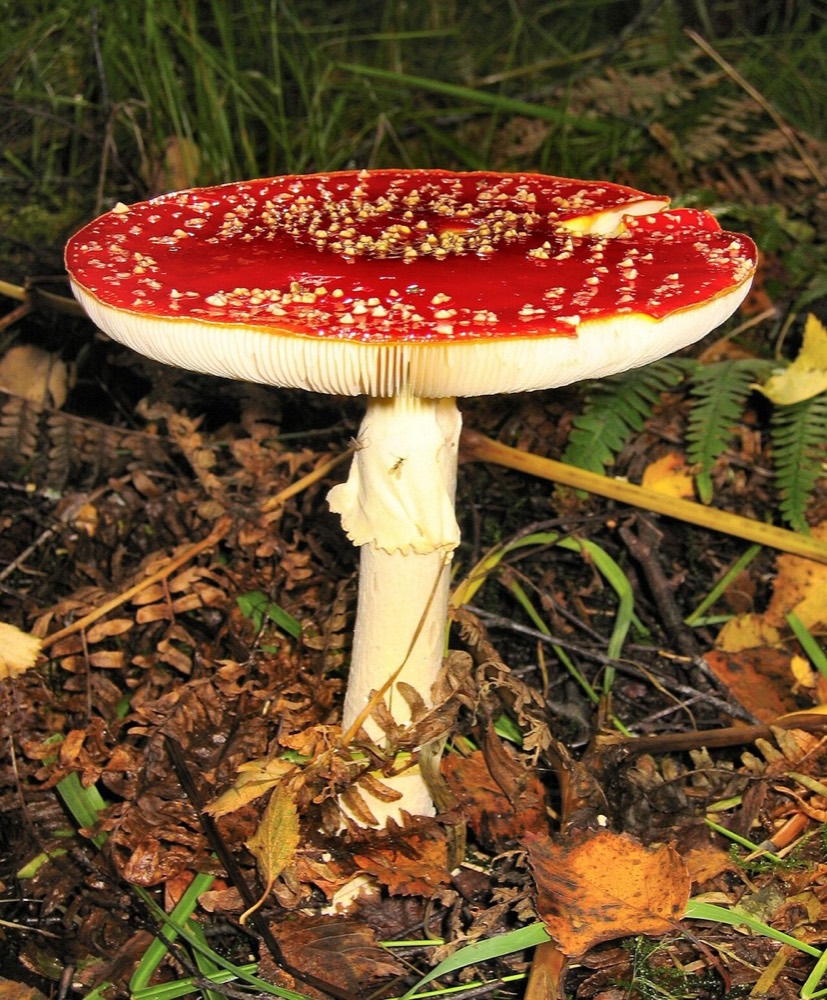
- Cap: Cap 5-30 cm, bright red covered with white warts.
- Gills: White, free gills.
- Stem, ring and volva: White stem 5-20 cm, with a white ring; base bears 2 to 4 distinct rings or ruffs left from the universal veil.
- Spore print: White.
- Where and when it grows: Forms mycorrhizal associations with pine, oak, spruce, fir, birch, cedar, and others; fruits in summer and autumn.
- Range in North America: Subsp. flavivolvata ranges from Alaska through the Rocky Mountains and Central America to Colombia; var. guessowii occurs in the northeast from Newfoundland and Quebec south to Tennessee.
How to recognise Fly agaric
- Cap: Cap 5-30 cm, bright red covered with white warts.
- Gills: White, free gills.
- Stem, ring and volva: White stem 5-20 cm, with a white ring; base bears 2 to 4 distinct rings or ruffs left from the universal veil.
- Spore print: White.
- Where and when it grows: Forms mycorrhizal associations with pine, oak, spruce, fir, birch, cedar, and others; fruits in summer and autumn.
- Range in North America: Subsp. flavivolvata ranges from Alaska through the Rocky Mountains and Central America to Colombia; var. guessowii occurs in the northeast from Newfoundland and Quebec south to Tennessee.
Easily confused with
- Caesar's mushroom, Amanita caesarea: Caesar's mushroom has a uniformly orange-red cap without white warts, and its stem, gills, and ring are all yellow.
What happens if it is eaten
Toxin: ibotenic acid and muscimol. Severity: serious poisoning. Timing: Onset around 30 to 90 minutes after ingestion, peaking within 3 hours. A delayed start is the dangerous part: hours without symptoms do not mean the mushroom was harmless.
What to do if someone may have eaten it
Call Poison Control at 1-800-222-1222 (U.S.) right away, or your local emergency number. Keep any leftover mushroom, a photo of it, and note when it was eaten. Do not wait for symptoms and do not try home remedies. This page does not give medical advice.
What a photo can and cannot do
A clear photo of the whole mushroom, including the base dug out of the ground, the gills and a spore print, lets the app and a mycologist narrow down what it might be and flag features that match Fly agaric. No photo, app or website can confirm that a wild mushroom is safe to eat. Use identification to know what to avoid, not what to cook.
Is there a red death cap mushroom?
No. The death cap, Amanita phalloides, is generally greenish: Wikipedia lists pale green, yellowish-green, olive-green, bronze and, in one form, white, and no red. A red mushroom with white spots is the fly agaric, which Wikipedia calls the most easily recognised toadstool.
The mix-up is understandable, because the two are close relatives. Both are Amanitas with white free gills, a ring on the stem and remains of a veil at the base, and both are poisonous. But they differ a great deal in how dangerous they are, so it matters which one someone has eaten.
Fly agaric vs death cap
- Cap: fly agaric red with white warts, 8 to 20 cm (Wildlife Trusts); death cap greenish, olive or white, smooth (Wikipedia).
- Toxins: fly agaric contains ibotenic acid and muscimol; death cap contains amatoxins (Wikipedia).
- Onset: fly agaric 30 minutes to 2 hours; death cap 6 to 12 hours with no symptoms first (Wikipedia, Mushroom poisoning).
- Effects: fly agaric often causes stomach cramps and hallucinations, with deaths rare (Wildlife Trusts); death cap destroys the liver, and about half a cap can kill (Wikipedia).
- Share of deaths: death cap about 90% of mushroom deaths (Wikipedia).
- Where and when: fly agaric under birch, pine and spruce, August to November in the UK (Wildlife Trusts); death cap mainly with oaks, including planted oaks in California (see death cap).
Red squirrels, slugs and fungus gnats eat fly agaric (Wildlife Trusts), which is a reminder that animals eating a mushroom says nothing about whether people can: Wikipedia lists 'animals avoid toxic mushrooms' among false folk beliefs.
Is it safe to touch a death cap mushroom?
This site does not call any poisonous mushroom safe to touch. Wikipedia's article on the death cap advises against even touching it. If you need to remove one from a yard, wear gloves or use a bag, keep it away from food, bin it rather than composting it, and wash your hands. If a child may have put any part in their mouth, call Poison Control at 1-800-222-1222 (US).
How poisonous is a death cap, and can poisoning be cured?
Wikipedia estimates that 30 grams, about half a cap, can kill an adult, and that cooking does not destroy the toxins. Many people survive with fast hospital treatment. Wikipedia lists silibinin (from milk thistle), high-dose intravenous penicillin G and, when the liver fails, transplantation, which is often the only option to prevent death. Mortality fell from 22.4% in a 1971 to 1980 European review to about 10 to 15% in surveys reviewed in 1995; it is about 10% for people hospitalised soon after eating and 50 to 90% for those admitted 60 hours or more later (Wikipedia). Time is the factor anyone can change: call as soon as a death cap might have been eaten.
How this page was made
Research and drafting for this page were assisted by AI and checked line by line against the sources listed below. Nothing on this page says a wild mushroom is safe to eat or safe to handle. If you find an error, tell us and we will correct it.
FAQ
Is fly agaric deadly?
Fly agaric is classed here as: serious poisoning. Its toxin is ibotenic acid and muscimol. Treat any suspected ingestion as an emergency.
Where does fly agaric grow?
Forms mycorrhizal associations with pine, oak, spruce, fir, birch, cedar, and others; fruits in summer and autumn.
Can the app tell me if a mushroom is safe to eat?
No. The app helps you see which features match known species, including toxic ones, so you know what to stay away from. It never declares a wild mushroom safe.
Is there a red death cap mushroom?
No. Death caps are greenish, olive, bronze or white (Wikipedia). The red mushroom with white spots is the fly agaric, a related Amanita that is poisonous but much less often fatal.
Is it safe to touch a death cap mushroom?
Wikipedia advises against even touching it. Use gloves or a bag if you must remove one, and wash your hands afterwards.
Can death cap mushroom poisoning be cured?
Many people survive with early hospital treatment, including silibinin, penicillin G and sometimes a liver transplant; mortality is about 10 to 15% overall and much higher when treatment is delayed (Wikipedia).
How poisonous is fly agaric compared with the death cap?
Fly agaric usually causes stomach cramps and hallucinations within 2 hours, and deaths are rare (Wildlife Trusts); the death cap causes about 90% of mushroom deaths (Wikipedia).
More in Toxic Mushrooms of North America
- Chlorophyllum molybdites Mushroom: Green-Spored Parasol ID
- Panther cap (Amanita pantherina): How to Recognise It
- Eastern jack-o'-lantern mushroom (Omphalotus illudens): How to Recognise It
- Ivory funnel (Clitocybe dealbata): How to Recognise It
- Ink Cap Mushroom Poisonous? Common Ink Cap and Alcohol
- Livid pinkgill (Entoloma sinuatum): How to Recognise It
Related
Learn what's growing around you.
Start with a single scan.
Take a photo to learn what it might be. Never eat a wild mushroom based on an app or a website.
Sources
- Wikipediaen.wikipedia.org/wiki/Amanita_muscaria
- North American Mycological Associationnamyco.org/interests/toxicology/mushroom-poisoning-syndromes/
- wildlifetrusts.orgwww.wildlifetrusts.org/wildlife-explorer/fungi/fly-agaric
- Wikipediaen.wikipedia.org/wiki/Amanita_phalloides
- Wikipediaen.wikipedia.org/wiki/Mushroom_poisoning
- Wikipediaen.wikipedia.org/wiki/Mushroom
Compiled by the MushroomLens editorial team
Every fact on this page is taken from the sources listed above; numbers and prices are copied from the source, and prices name the guide or auction and its date. Research and drafting were assisted by AI, and each claim was then checked against the cited sources. Checked 2026-09-25. We do not buy, sell or grade items; the app identifies what you photograph and points you to these references.