
Ink Cap Mushroom Poisonous? Common Ink Cap and Alcohol
Quick answer
The common ink cap (Coprinopsis atramentaria) contains coprine: alcohol up to 3 days after eating it can bring flushing and vomiting in 5 to 10 minutes.
Updated 2026-09-25 · Sources: Wikipedia, MushroomExpert.com, wildfooduk.com, petmd.com
Take a photo to learn what it might be. Never eat a wild mushroom based on an app or a website.
Download on the App StoreWhat are the key facts?
- Scientific name: Coprinopsis atramentaria
- Common names: common ink cap, tippler's bane
- Toxin: coprine (reacts with alcohol)
- Severity: serious poisoning
- First symptoms: Facial flushing, nausea, and vomiting appear within 5 to 10 minutes of drinking alcohol.
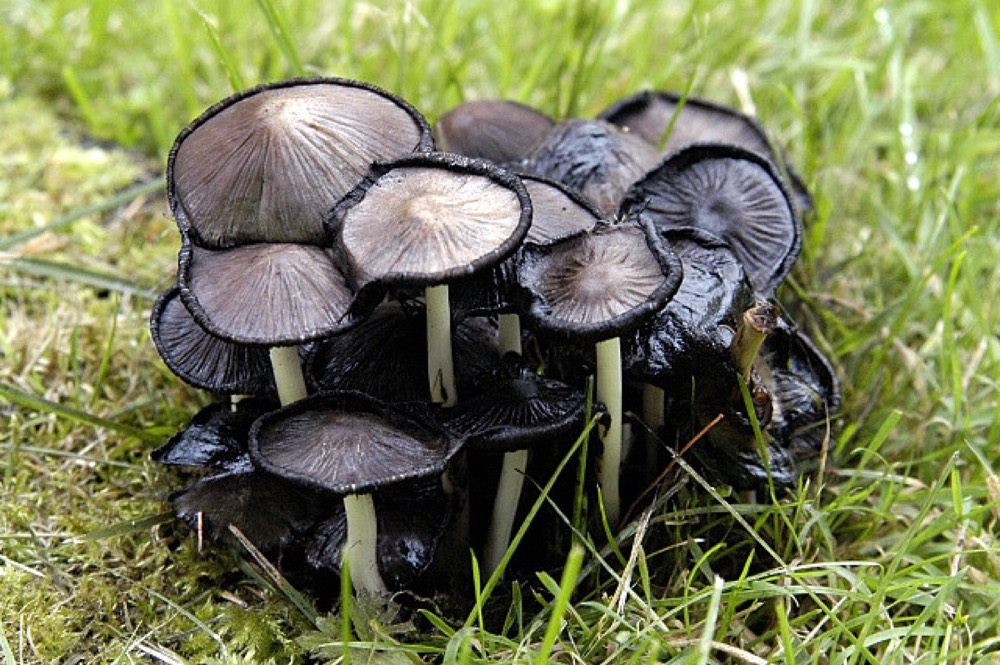
- Cap: Grayish-brown, furrowed; bell-shaped at first, later flattening, with a splitting margin.
- Gills: Crowded, free gills; white at first, turning gray or pink, then black, and finally deliquescing (self-digesting into liquid).
- Stem, ring and volva: Stem 5-17 cm tall, 1-2 cm thick, gray, no ring, hollow.
- Spore print: Black.
- Where and when it grows: Clustered on decaying stumps and roots; common in lawns, disturbed ground, and urban settings; late spring through autumn.
- Range in North America: Widely distributed in North America.
How to recognise Common ink cap
- Cap: Grayish-brown, furrowed; bell-shaped at first, later flattening, with a splitting margin.
- Gills: Crowded, free gills; white at first, turning gray or pink, then black, and finally deliquescing (self-digesting into liquid).
- Stem, ring and volva: Stem 5-17 cm tall, 1-2 cm thick, gray, no ring, hollow.
- Spore print: Black.
- Where and when it grows: Clustered on decaying stumps and roots; common in lawns, disturbed ground, and urban settings; late spring through autumn.
- Range in North America: Widely distributed in North America.
What happens if it is eaten
Toxin: coprine (reacts with alcohol). Severity: serious poisoning. Timing: Facial flushing, nausea, and vomiting appear within 5 to 10 minutes of drinking alcohol. A delayed start is the dangerous part: hours without symptoms do not mean the mushroom was harmless.
What to do if someone may have eaten it
Call Poison Control at 1-800-222-1222 (U.S.) right away, or your local emergency number. Keep any leftover mushroom, a photo of it, and note when it was eaten. Do not wait for symptoms and do not try home remedies. This page does not give medical advice.
What a photo can and cannot do
A clear photo of the whole mushroom, including the base dug out of the ground, the gills and a spore print, lets the app and a mycologist narrow down what it might be and flag features that match Common ink cap. No photo, app or website can confirm that a wild mushroom is safe to eat. Use identification to know what to avoid, not what to cook.
Is the ink cap mushroom poisonous?
It is poisonous in combination with alcohol, which is why sources disagree on how to label it. Wikipedia describes the common ink cap as edible when eaten young on its own but dangerous with alcohol. Wild Food UK classes it as poisonous and does not recommend eating it at all, noting it should never be eaten raw. This site treats it as a poisonous mushroom.
Its toxin, coprine, does nothing by itself. Wikipedia explains that a breakdown product of coprine blocks acetaldehyde dehydrogenase, the enzyme that clears alcohol's first breakdown product from the body, so a drink causes a reaction like the one produced by the alcohol-aversion drug disulfiram.
Why can't you drink alcohol after eating an inky cap mushroom?
Because the blocked enzyme lets acetaldehyde build up. According to Wikipedia:
- Onset: 5 to 10 minutes after drinking.
- Symptoms: reddening of the face, nausea, vomiting, palpitations and tingling in the limbs; heart attack and irregular heart rhythm have been reported.
- Duration: usually two to three hours if no more alcohol is drunk.
- Risk window: up to three days after eating the mushroom, weakening over time.
Wild Food UK gives a 48-hour window before or after the meal and warns that even alcohol in aftershave can set it off. If someone has eaten one, follow the longer of the two: no alcohol for at least three days afterwards.
If someone has a reaction, call Poison Control at 1-800-222-1222 (US) or emergency services if there is chest pain or a racing heart.
Common ink cap vs shaggy ink cap
Both melt into black ink from the gill edge upward, and both grow in lawns and disturbed ground, so they are often confused.
- Common ink cap (Coprinopsis atramentaria): smooth grey-brown cap 3 to 10 cm wide, bell-shaped then furrowed and splitting, without shaggy scales; grows in tufts from buried wood (Wikipedia; Wild Food UK). Contains coprine.
- Shaggy ink cap or shaggy mane (Coprinus comatus): a tall, almost cylindrical white cap 4 to 8 cm wide and 6 to 20 cm high, covered in shaggy scales that are pale brown at the top (Wikipedia). Wikipedia states it does not contain coprine.
- Magpie inkcap: Wild Food UK lists it as an inedible look-alike with a distinctive pattern.
The shaggy mane has its own dangerous confusion: Wikipedia notes that young green-spored parasols (Chlorophyllum molybdites) are mistaken for it and cause many poisonings. See green-spored parasol and black mushrooms in yard.
Are inky caps toxic to dogs?
We did not find a veterinary source describing inky cap poisoning in dogs specifically. The coprine reaction needs alcohol, but Wikipedia reports that coprine showed toxic effects on the reproductive organs of rats and dogs in testing, so eating it is not harmless. petMD's advice covers every case: treat any mushroom a pet eats as potentially toxic and have the pet seen by a vet immediately. In the US you can also call ASPCA Animal Poison Control on (888) 426-4435; NAMA notes that animal poison control services charge a fee. Take the mushroom or a photo with you.
What happens if someone eats a death cap by mistake?
A death cap is not an ink cap, but both turn up in the same searches and the outcomes could not be more different. Wikipedia describes 6 to 12 hours with no symptoms, then about a day of vomiting and diarrhoea, then liver damage 1 to 3 days after eating. Mortality was about 10% for people hospitalised soon after eating and 50 to 90% for those admitted 60 hours or more later. If there is any chance a mushroom eaten was an Amanita, call Poison Control immediately; do not wait for symptoms. The two are compared side by side in death cap vs ink cap.
The ink in the name
The name is literal. Wikipedia notes that the black liquid the mushroom releases after picking was once used as ink. The gills digest themselves from the edge inward, which Wild Food UK describes as melting to a black ink, so a specimen collected in the evening may be a black smear by morning. Photograph it as soon as you find it.
How this page was made
Research and drafting for this page were assisted by AI and checked line by line against the sources listed below. Nothing on this page says a wild mushroom is safe to eat or safe to handle. If you find an error, tell us and we will correct it.
FAQ
Is common ink cap deadly?
Common ink cap is classed here as: serious poisoning. Its toxin is coprine (reacts with alcohol). Treat any suspected ingestion as an emergency.
Where does common ink cap grow?
Clustered on decaying stumps and roots; common in lawns, disturbed ground, and urban settings; late spring through autumn.
Can the app tell me if a mushroom is safe to eat?
No. The app helps you see which features match known species, including toxic ones, so you know what to stay away from. It never declares a wild mushroom safe.
Is the ink cap mushroom poisonous?
Yes when combined with alcohol. It contains coprine, which causes flushing, nausea, vomiting and palpitations if alcohol is drunk within about three days of eating it (Wikipedia). Wild Food UK classes it as poisonous.
Why can't you drink alcohol after eating an inky cap mushroom?
Coprine's breakdown product blocks the enzyme that clears acetaldehyde, so alcohol produces a disulfiram-like reaction within 5 to 10 minutes (Wikipedia).
How long after eating ink caps should you avoid alcohol?
Wikipedia gives up to three days; Wild Food UK says 48 hours before or after. Use the longer figure.
Are inky caps toxic to dogs?
No veterinary source we found describes it specifically, but coprine was toxic to dogs' reproductive organs in testing (Wikipedia). petMD advises treating any mushroom a pet eats as potentially toxic and seeing a vet at once.
Is the shaggy ink cap the same as the common ink cap?
No. The shaggy ink cap (Coprinus comatus) is tall, white and shaggy, and Wikipedia says it does not contain coprine; the common ink cap is smooth grey-brown and does.
More in Toxic Mushrooms of North America
- Chlorophyllum molybdites Mushroom: Green-Spored Parasol ID
- Fly agaric (Amanita muscaria): How to Recognise It
- Panther cap (Amanita pantherina): How to Recognise It
- Eastern jack-o'-lantern mushroom (Omphalotus illudens): How to Recognise It
- Ivory funnel (Clitocybe dealbata): How to Recognise It
- Livid pinkgill (Entoloma sinuatum): How to Recognise It
Related
Learn what's growing around you.
Start with a single scan.
Take a photo to learn what it might be. Never eat a wild mushroom based on an app or a website.
Sources
- Wikipediaen.wikipedia.org/wiki/Coprinopsis_atramentaria
- MushroomExpert.comwww.mushroomexpert.com/coprinopsis_atramentaria.html
- wildfooduk.comwww.wildfooduk.com/mushroom-guide/common-inkcap/
- Wikipediaen.wikipedia.org/wiki/Coprinus_comatus
- Wikipediaen.wikipedia.org/wiki/Mushroom_poisoning
- petmd.comwww.petmd.com/dog/poisoning/mushroom-poisoning-in-dogs
- North American Mycological Associationnamyco.org/interests/toxicology/mushroom-poisonings-in-dogs-and-cats/
Compiled by the MushroomLens editorial team
Every fact on this page is taken from the sources listed above; numbers and prices are copied from the source, and prices name the guide or auction and its date. Research and drafting were assisted by AI, and each claim was then checked against the cited sources. Checked 2026-09-25. We do not buy, sell or grade items; the app identifies what you photograph and points you to these references.