
Chlorophyllum molybdites Mushroom: Green-Spored Parasol ID
Quick answer
Chlorophyllum molybdites is the most commonly eaten poisonous mushroom in North America; symptoms start 1 to 3 hours later. How to spot its green spores.
Updated 2026-09-25 · Sources: Wikipedia, ask.ifas.ufl.edu, extension.illinois.edu, cdph.ca.gov
Take a photo to learn what it might be. Never eat a wild mushroom based on an app or a website.
Download on the App StoreWhat are the key facts?
- Scientific name: Chlorophyllum molybdites
- Common names: green-spored parasol, false parasol
- Toxin: gastrointestinal irritant (molybdophyllysin)
- Severity: serious poisoning
- First symptoms: Gastrointestinal symptoms appear 1 to 3 hours after ingestion.
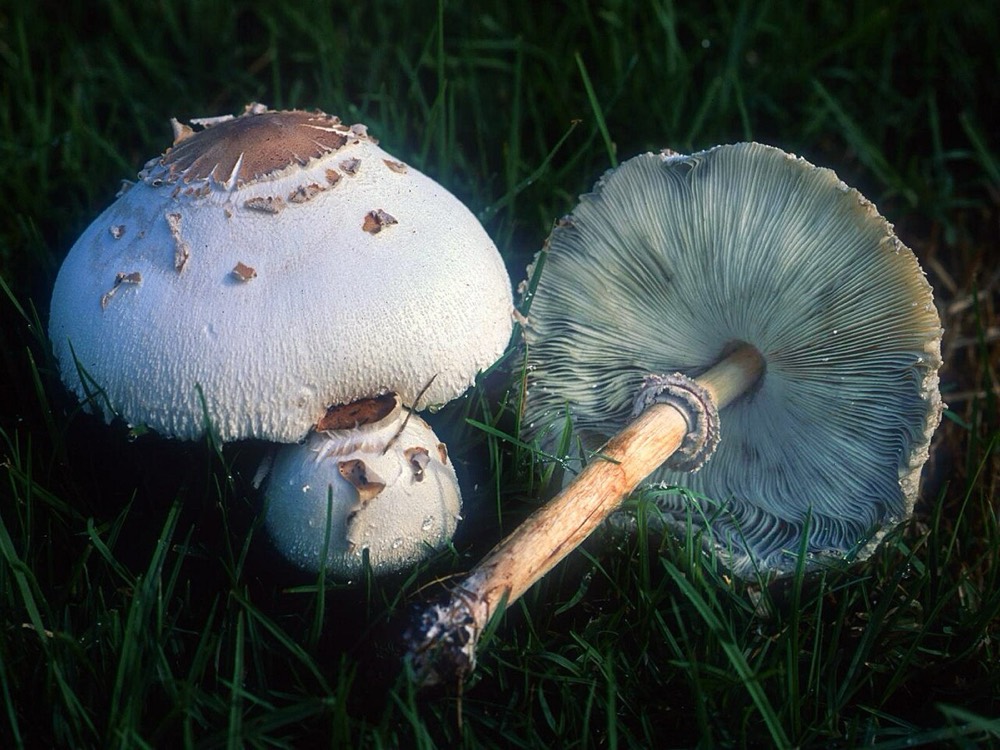
- Cap: Cap 8-30 cm wide, white background covered with coarse brown scales.
- Gills: Free gills, white, turning dark green at maturity.
- Stem, ring and volva: Stem bears a double-edged ring.
- Spore print: Green (the only large North American gilled mushroom with a green spore print).
- Where and when it grows: Lawns and parks, appearing after summer and autumn rains.
- Range in North America: Common in eastern North America; also found in temperate and subtropical regions worldwide.
How to recognise Green-spored parasol
- Cap: Cap 8-30 cm wide, white background covered with coarse brown scales.
- Gills: Free gills, white, turning dark green at maturity.
- Stem, ring and volva: Stem bears a double-edged ring.
- Spore print: Green (the only large North American gilled mushroom with a green spore print).
- Where and when it grows: Lawns and parks, appearing after summer and autumn rains.
- Range in North America: Common in eastern North America; also found in temperate and subtropical regions worldwide.
Easily confused with
- shaggy parasol / parasol mushroom (Macrolepiota, Chlorophyllum rhacodes, ): Its stem lacks the snakeskin pattern characteristic of the parasol mushroom.
What happens if it is eaten
Toxin: gastrointestinal irritant (molybdophyllysin). Severity: serious poisoning. Timing: Gastrointestinal symptoms appear 1 to 3 hours after ingestion. A delayed start is the dangerous part: hours without symptoms do not mean the mushroom was harmless.
What to do if someone may have eaten it
Call Poison Control at 1-800-222-1222 (U.S.) right away, or your local emergency number. Keep any leftover mushroom, a photo of it, and note when it was eaten. Do not wait for symptoms and do not try home remedies. This page does not give medical advice.
What a photo can and cannot do
A clear photo of the whole mushroom, including the base dug out of the ground, the gills and a spore print, lets the app and a mycologist narrow down what it might be and flag features that match Green-spored parasol. No photo, app or website can confirm that a wild mushroom is safe to eat. Use identification to know what to avoid, not what to cook.
Is Chlorophyllum molybdites edible?
No. It is poisonous, and it is the mushroom behind more poisonings than any other in the region: Wikipedia calls it the most commonly consumed poisonous mushroom in North America, and University of Florida IFAS Extension calls it the most common cause of mushroom poisoning in the United States.
UF/IFAS reports symptoms 1 to 2 hours after eating: nausea, vomiting, diarrhoea, abdominal pain, dizziness, chills and cold sweats, and in severe cases low blood pressure and shock from fluid loss. Symptoms can last from 4 hours to 7 days, though most patients recover within 24 hours. There is no known antidote, and young children and pets are at higher risk because of their size. If anyone may have eaten one, call Poison Control at 1-800-222-1222 (U.S.) now, before symptoms start.
The green spore print check
The single most useful feature is the spore print. UF/IFAS describes it as obviously green, a rare feature among mushrooms, and Wikipedia calls it the only large mushroom with a green spore print.
- Cut the cap from the stem and lay it gills-down on white paper.
- Cover it with a bowl and leave it for several hours.
- A green to greenish deposit means Chlorophyllum molybdites. Older gills also turn green to greenish brown.
- Other features: a cap 1.8 to 11.8 inches wide, white to brown with beige, cinnamon or pinkish-brown scales (UF/IFAS); a thick ring on the stem; and, per Wikipedia, no snakeskin pattern on the stem, which the true parasol mushroom has.
It is most often mistaken for the shaggy parasol and the parasol mushroom (Wikipedia). Wear gloves or wash your hands afterwards.
When it shows up in lawns
UF/IFAS records it in Florida during spring, summer and fall, roughly April to November, with more mushrooms in wet weather. It grows singly, in clusters, or in complete or partial fairy rings on lawns. Wikipedia describes it in meadows, lawns and parks across eastern North America and in temperate and subtropical regions worldwide.
Because it favours lawns and parks, it is the large mushroom children are most likely to find. See poisonous lawn mushroom types.
How to get rid of Chlorophyllum molybdites in your yard
You can remove the mushrooms, but not the fungus, with a quick fix. Illinois Extension states there are no recommended fungicides for these lawn species, and advises breaking or mowing off mushrooms when they first appear if children or pets might contact them, and digging up buried organic matter where many mushrooms appear.
- Walk the lawn after rain in the warm months, when new ones appear.
- Pick them with gloves or a bag, seal them and put them in the trash, not the compost.
- Mow or knock down new ones before children or dogs reach them.
- Expect them back while the underground fungus has food. The full method is on how to get rid of mushrooms in a lawn.
Green-spored parasol vs the true parasol and the shaggy parasol
The green-spored parasol is most often mistaken for the parasol mushroom, Macrolepiota procera, and the shaggy parasol, Chlorophyllum rhacodes (Wikipedia). Compare them feature by feature:
- Spore print. Green-spored parasol: green. Parasol: white. Shaggy parasol: white (Wikipedia for all three). This is the check that decides.
- Stem pattern. The parasol has a tall stem, 12 to 40 cm, with scaly bands that look like snakeskin below a movable ring. The green-spored parasol's stem, 5 to 30 cm, lacks the snakeskin pattern and carries a double-edged ring (Wikipedia).
- Cap. Green-spored parasol 8 to 30 cm, whitish with brownish scales; parasol up to 25 cm with a smooth dark bump in the centre; shaggy parasol about 6 to 20 cm (Wikipedia).
- Gills with age. The green-spored parasol's gills turn dark and greenish as it matures; the parasol's stay white or turn pale pink (Wikipedia).
- Cut flesh. The shaggy parasol turns reddish or maroon when damaged and gives off a pungent smell (Wikipedia).
- Where. The green-spored parasol grows in lawns, meadows and parks across eastern North America and often forms fairy rings. The parasol grows on well-drained soils in pastures and occasionally woodland and is described as widespread in temperate Eurasia and possibly North America. The shaggy parasol prefers shade and avoids open pasture (Wikipedia).
In a North American lawn, a large scaly parasol-shaped mushroom should be treated as the green-spored parasol until a spore print and an expert say otherwise.
When the spore print is not green
The green print is the textbook test, but it is not always clean. The naturalist behind Backyard Nature reports that specimens identified as Chlorophyllum molybdites in a horse pasture, growing in a line that was part of a large fairy ring, produced pale grey prints even though the books describe green. Two practical points follow: take the print from a mature cap whose gills have started to darken, and never read a white or grey print on a large lawn parasol as proof that it is harmless. Backyard Nature's account of the poisoning describes symptoms within about 2 hours, repeated waves of vomiting, then severe diarrhoea, chills and fever lasting more than 24 hours. If anyone has eaten one, call Poison Control at 1-800-222-1222 (U.S.).
Is the parasol mushroom poisonous?
'Parasol' is used for several different mushrooms, and the answer depends on which one:
- Green-spored or false parasol, Chlorophyllum molybdites: poisonous. Texas A&M AgriLife reports its nickname is the 'vomiter', calls it one of the most consumed poisonous mushrooms in the US, and says people mistake it for puffballs or button mushrooms as well as for true parasols.
- Parasol, Macrolepiota procera: Wikipedia describes it as well regarded as an edible in Europe, with a cap up to 25 cm, a tall stem 12 to 40 cm with a snakeskin pattern below a movable ring, and a white spore print. Wikipedia also says its presence in North America is not confirmed.
- Shaggy parasols, Chlorophyllum rhacodes, C. olivieri and C. brunneum: listed by UF/IFAS Extension among the green-spored parasol's look-alikes.
- Small parasols in the genus Lepiota: Wikipedia warns that Lepiota brunneoincarnata, a parasol look-alike, has caused fatal poisonings in Spain. See deadly Lepiota.
- Young white Amanitas: Wikipedia gives a contrast: parasols have darker flakes on a lighter cap, Amanitas the opposite.
So a 'parasol mushroom' on a North American lawn should be treated as the poisonous one until an expert says otherwise. UF/IFAS adds that children and pets are at higher risk because of their smaller size and their tendency to eat fresh lawn mushrooms.
Why white mushrooms like this appear overnight
Texas A&M AgriLife explains that the fungus lives underground on decaying organic matter, and after heavy rain it pushes up mushrooms mostly by expanding cells it has already made rather than growing new ones, which is why they seem to appear overnight. Picking them does not remove the fungus. Plant pathologist Brian Shaw's advice there is to enjoy them as part of the landscape, and the article says to contact poison control if anyone eats one.
How this page was made
Research and drafting for this page were assisted by AI and checked line by line against the sources listed below. Nothing on this page says a wild mushroom is safe to eat or safe to handle. If you find an error, tell us and we will correct it.
FAQ
Is green-spored parasol deadly?
Green-spored parasol is classed here as: serious poisoning. Its toxin is gastrointestinal irritant (molybdophyllysin). Treat any suspected ingestion as an emergency.
Where does green-spored parasol grow?
Lawns and parks, appearing after summer and autumn rains.
Can the app tell me if a mushroom is safe to eat?
No. The app helps you see which features match known species, including toxic ones, so you know what to stay away from. It never declares a wild mushroom safe.
Are Chlorophyllum molybdites edible?
No. It is poisonous and the most commonly eaten poisonous mushroom in North America (Wikipedia). Symptoms start 1 to 3 hours after eating.
Is Chlorophyllum molybdites a poisonous mushroom?
Yes. UF/IFAS Extension calls it the most common cause of mushroom poisoning in the United States, with severe vomiting and diarrhoea lasting from 4 hours to 7 days.
How can I get rid of Chlorophyllum molybdites in my yard?
Pick or mow the mushrooms as they appear and bin them; Illinois Extension lists no recommended fungicide. Removing buried wood and organic matter reduces future flushes.
Can I touch Chlorophyllum molybdites?
CDPH says touching a poisonous mushroom usually does not pose a risk; wash your hands afterwards. Use gloves or a bag when clearing a lawn, and keep the mushrooms away from children and pets.
What is the difference between green spored parasol and a real parasol?
The spore print: green for the green-spored parasol, white for the parasol (Macrolepiota procera). The parasol also has a snakeskin-patterned stem below a movable ring, which the green-spored parasol lacks (Wikipedia). Only an expert should confirm either.
What is the deadliest fungus to humans?
The death cap, Amanita phalloides. Wikipedia estimates about 30 grams, roughly half a cap, can kill an adult. The green-spored parasol causes more poisonings in North America but, per Wikipedia, deaths from it have been incredibly rare. See [death cap](/lookup/toxic-mushrooms/amanita-phalloides).
Is a parasol mushroom safe to eat?
This site does not say any wild mushroom is safe to eat. The name covers the poisonous green-spored parasol, which is one of the most commonly eaten poisonous mushrooms in the US (Texas A&M AgriLife), as well as the European parasol and deadly Lepiota look-alikes. Only an expert examining the specimen can identify it.
Why is the false parasol called the vomiter?
Because eating it causes vomiting and diarrhoea, usually 1 to 2 hours later and sometimes severe enough to cause shock from fluid loss (UF/IFAS; Texas A&M AgriLife).
More in Toxic Mushrooms of North America
- Fly agaric (Amanita muscaria): How to Recognise It
- Panther cap (Amanita pantherina): How to Recognise It
- Eastern jack-o'-lantern mushroom (Omphalotus illudens): How to Recognise It
- Ivory funnel (Clitocybe dealbata): How to Recognise It
- Ink Cap Mushroom Poisonous? Common Ink Cap and Alcohol
- Livid pinkgill (Entoloma sinuatum): How to Recognise It
Related
Learn what's growing around you.
Start with a single scan.
Take a photo to learn what it might be. Never eat a wild mushroom based on an app or a website.
Sources
- Wikipediaen.wikipedia.org/wiki/Chlorophyllum_molybdites
- ask.ifas.ufl.eduask.ifas.ufl.edu/publication/PP324
- extension.illinois.eduextension.illinois.edu/lawns/managing-fairy-rings-and-mushrooms
- cdph.ca.govwww.cdph.ca.gov/Programs/CCDPHP/DEODC/EHIB/pages/eis/poisonous-mushrooms.aspx
- holdenfg.orgholdenfg.org/blog/common-lawn-mushrooms-and-what-to-do-about-them/
- Wikipediaen.wikipedia.org/wiki/Macrolepiota_procera
- Wikipediaen.wikipedia.org/wiki/Chlorophyllum_rhacodes
- backyardnature.netwww.backyardnature.net/n/x/green-sp.htm
- Wikipediaen.wikipedia.org/wiki/Amanita_phalloides
- agrilifetoday.tamu.eduagrilifetoday.tamu.edu/2025/07/29/what-are-those-white-mushrooms/
Compiled by the MushroomLens editorial team
Every fact on this page is taken from the sources listed above; numbers and prices are copied from the source, and prices name the guide or auction and its date. Research and drafting were assisted by AI, and each claim was then checked against the cited sources. Checked 2026-09-25. We do not buy, sell or grade items; the app identifies what you photograph and points you to these references.